Rodent mechanical exclusion relies on structural carpentry and material engineering rather than ongoing chemical suppression. In mature Oak Ridge properties, ranging from mid-century crawlspaces in Woodland and…
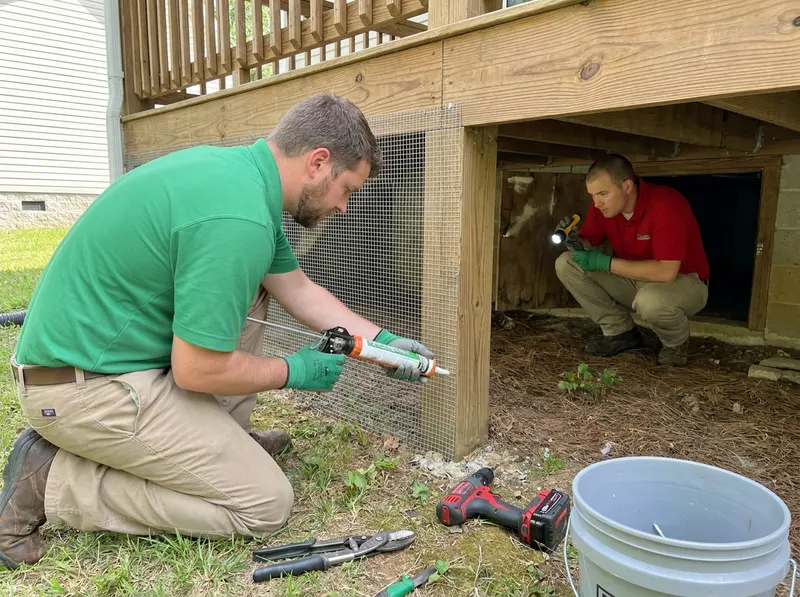
Rodent mechanical exclusion relies on structural carpentry and material engineering rather than ongoing chemical suppression. In mature Oak Ridge properties, ranging from mid-century crawlspaces in Woodland and Highland View to slab constructions along Melton Hill Lake in Rivers Run, Norway rats and field mice take advantage of the junction points where foundation sills meet framing. Mice require a breach of only one-quarter inch (6.35 mm), while adult rats enter through gaps measuring one-half inch (12.7 mm). Standard expanding foam or exterior caulk fails because rodents chew through soft matrices within hours. Mechanical exclusion utilizes 19-gauge hot-dipped galvanized steel wire cloth, custom-bent 26-gauge aluminum flashing, and specialized rodent-resistant elastomeric sealants that halt gnawing activity entirely at crawlspace vents, weep holes, and roofline soffit intersections.
Sanitation forms the critical secondary phase of structural rodent defense. Once entry paths are physically barricaded, the pheromone trails embedded in nesting sites, urine-soaked joists, and droppings continue to attract exterior populations toward the structure. The trade-off between exterior trapping alone and comprehensive exclusion with sanitation is clear: exterior traps only thin surface populations temporarily, whereas structural sealing paired with biological neutralizers terminates indoor attraction permanent-style without risking secondary rodenticide poisoning to local wildlife around Haw Ridge Park or domestic pets inside Emory Valley subdivisions. HEPA-filtered vacuum systems remove dried biohazards without dispersing microscopic pathogens into interior air ducts, followed by an application of non-volatile, botanical enzyme biocides directly onto crawlspace wood framing.
Service sequencing follows three clear phases. First, an exterior envelope inspection maps every penetration from grade level up to ridge vents, documenting pipe sleeves and fascia openings. Second, physical barricading seals all structural breaches using metal materials cut to exact tolerances. Third, technicians extract soiled insulation, eliminate localized nesting pockets, apply enzyme neutralizers across contaminated timber surfaces, and place interior mechanical capture stations to remove any rodents stranded indoors before complete seal verification.
Every job gets a firm, written price after a free on-site visit.
Tell us about your rodent mechanical exclusion and sanitation job in Oak Ridge and we'll send a clear, written quote, usually the same day.
 Norevia Pest Protection