Subterranean termite soil treatment creates an uninterrupted treated zone in the soil directly adjacent to foundation walls, concrete slabs, and crawlspace support piers. Eastern subterranean termites live beneath the…
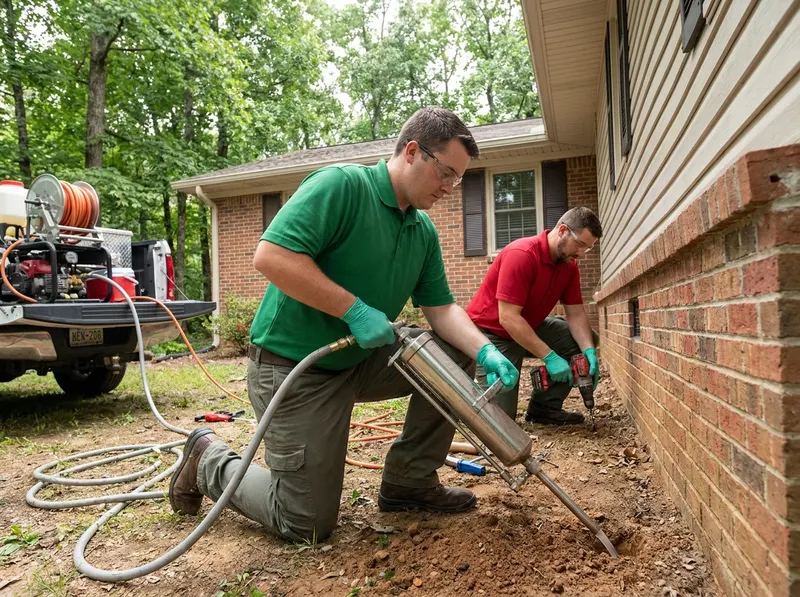
Subterranean termite soil treatment creates an uninterrupted treated zone in the soil directly adjacent to foundation walls, concrete slabs, and crawlspace support piers. Eastern subterranean termites live beneath the frost line in East Tennessee's dense clay soils and construct mud shelter tubes over masonry to reach structural sills, floor joists, and subflooring. An effective soil defense saturates the dirt down to the footing level using non-repellent termiticides such as fipronil at a regulated 0.06% finished dilution. Foraging workers enter the treated zone without detection, pick up the compound, and transfer it throughout the subterranean nest via social grooming, neutralizing the colony without releasing volatile organic airborne residues into living spaces.
Foundation construction across Oak Ridge dictates the appropriate treatment methodology. Mid-century basement and crawlspace homes in Woodland, Highland View, and Scarboro frequently feature porous cinder block foundations where termites exploit internal block voids. These sites require horizontal drilling through exterior mortar joints or interior slab perimeters alongside vertical trenching. In contrast, newer slab-on-grade construction in Briarcliff, Centennial Bluff, Rivers Run, and Country Club Estates requires perimeter rod injections and expansion joint treatments to prevent entry through plumbing penetrations. Properties near the moist, wooded margins of Melton Hill Lake, Haw Ridge Park, and Emory Valley face higher ground-moisture levels that accelerate termite foraging, making continuous exterior barriers preferable to isolated spot applications.
Selecting between continuous liquid soil barriers and exterior bait station arrays depends on structural accessibility and property boundaries. Liquid perimeter barriers provide immediate subterranean defense by establishing a continuous lethal zone within 4 to 6 hours of injection, but they require trenching 6 inches wide by 6 inches deep along all foundation perimeters. In contrast, subterranean bait stations installed at 10- to 20-foot intervals eliminate colonies through slow-acting insect growth regulators over several months, avoiding invasive drilling through finished porches, attached garages, or custom brick walkways in Westwood. Liquid treatments require no multi-year monitoring contract to remain active, as modern non-repellent formulations bind securely to local red clay soils for 5 to 10 years without leaching into groundwater reserves.
Every job gets a firm, written price after a free on-site visit.
Tell us about your subterranean termite soil treatment and structural defense job in Oak Ridge and we'll send a clear, written quote, usually the same day.
 Norevia Pest Protection