Stinging insect nesting behavior in Anderson County and Roane County shifts dramatically between late May and mid-September. Riparian microclimates near Melton Hill Lake and elevated hardwood canopies bordering Haw…
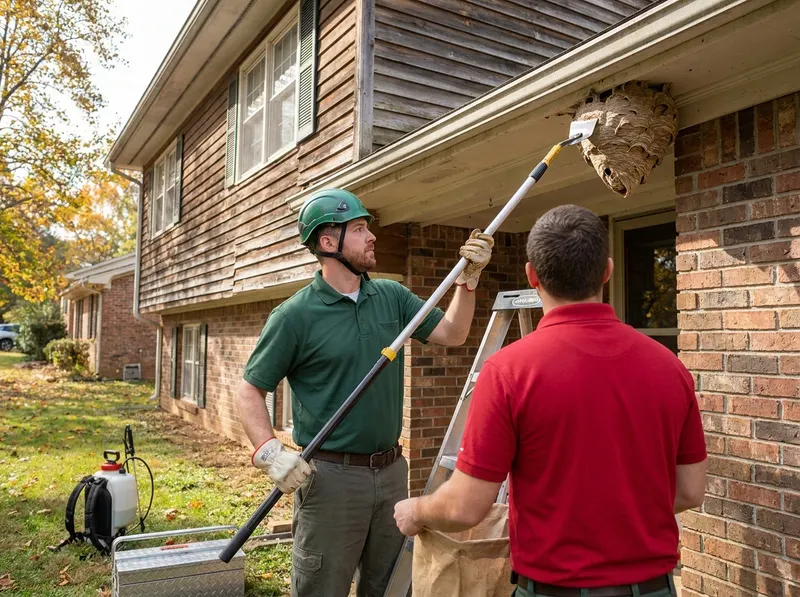
Stinging insect nesting behavior in Anderson County and Roane County shifts dramatically between late May and mid-September. Riparian microclimates near Melton Hill Lake and elevated hardwood canopies bordering Haw Ridge Park generate high insect biomass, prompting fertilized queen hornets to seek sheltered architectural overhangs. In residential neighborhoods like Emory Valley and Briarcliff, mid-century construction features broad exterior fascia and vented soffit gaps that act as thermal attractants. Rather than dispersing broad-spectrum synthetic neurotoxins that enter residential air systems, physical extraction physically eliminates the nesting core, larvae, and pheromone base plate while preserving surrounding native pollinators.
Selecting mechanical extraction and structural defense over continuous chemical drenching resolves the problem of seasonal re-infestation. Aerosol sprays leave residual reproductive queens unhindered in unsealed attic voids and fail to remove the paper nest, which continues emitting aggregation cues that lure scout wasps the following spring. Mechanical nest removal physically severs the attachment stem, vacuums active foragers with high-efficiency particulate capture systems, and applies dry silicone elastomer barriers directly inside the target corner seam. The primary trade-off involves access complexity: two-story structures along steep hillside lots in Westwood, Country Club Estates, or Highland View require ladder stabilization gear or boom reach, which dictates procedural time rather than chemical contact volume.
1. Structural diagnostic inspection: Mapping flight vectors, exterior entry voids, and identifying the stinging species along gutters, dormers, and eaves.
2. Manual containment: Deploying high-reach extension scrapers and specialized negative-pressure vacuums to detach nests without rupturing comb chambers.
3. Residue cleaning: Scraping residual pedicel anchoring cement and organic matter off siding or masonry to eradicate re-nesting scent markers.
4. Architectural eaves defense: Installing galvanized 1/8-inch steel hardware cloth over exposed intake vents and non-toxic elastomeric sealants along shadow board gaps.
Every job gets a firm, written price after a free on-site visit.
Tell us about your stinging insect mechanical nest removal and eaves defense job in Oak Ridge and we'll send a clear, written quote, usually the same day.
 Norevia Pest Protection