Properties across Anderson County and Roane County feature dense hardwood canopies, limestone runoffs, and natural watershed ravines that support persistent populations of biting arthropods. In riverside pockets near…
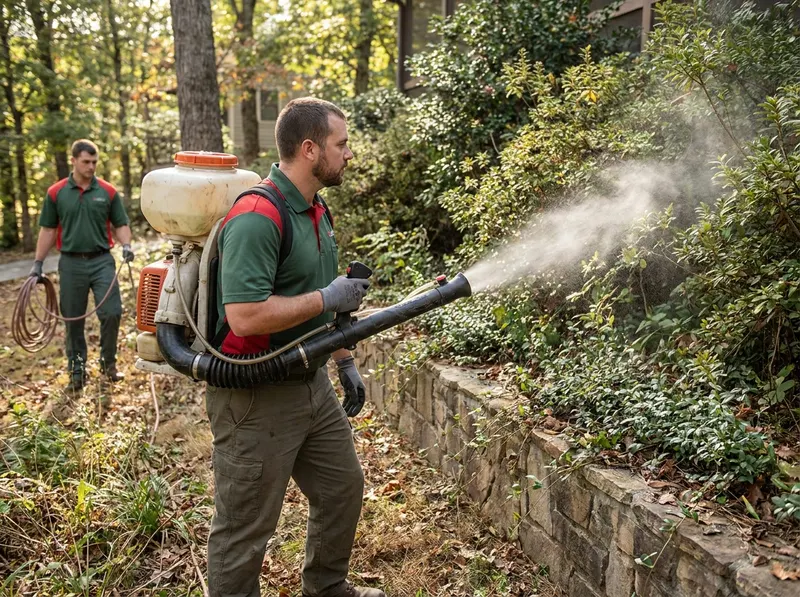
Properties across Anderson County and Roane County feature dense hardwood canopies, limestone runoffs, and natural watershed ravines that support persistent populations of biting arthropods. In riverside pockets near Melton Hill Lake or sloped foothill properties along Haw Ridge Park, microclimates trap high humidity beneath low-hanging oak, pine, and underbrush canopies. Targeted perimeter mosquito and tick misting directly manages these vector-heavy transition zones. Rather than saturating open sod or broadcasting broad-spectrum compounds near pollinator gardens, technicians direct directional misting equipment into the specific micro-habitats where adult mosquitoes rest during peak midday heat, the undersides of broadleaf shrubs, ground-cover ivy, retaining wall seams, and shaded wood margins.
Selecting targeted perimeter barrier misting fits residential properties bordering unmanaged greenways, such as heavily wooded lots in Emory Valley, Briarcliff, and Country Club Estates. If an outdoor gathering area experiences sustained biting pressure within 20 feet of woodland edges, perimeter misting intercepts vectors before they reach patios, decks, or screen enclosures. Conversely, if standing water in clogged rain gutters or low-drainage swales remains unaddressed, adult misting alone yields limited duration; integrating larvicide briquettes into standing catchment basins provides the required multi-stage control. The operational trade-off centers on spatial scope: perimeter barrier treatments preserve open turf ecology and beneficial garden insects while establishing a residual boundary that degrades steadily over 21 to 30 days under natural rainfall.
Residential lots spanning neighborhood ridges like Highland View, Woodland, Westwood, and Centennial Bluff often present steep elevation transitions that concentrate leaf litter and moisture runoff. Ticks climb the tips of long grasses and perimeter brush at heights between 6 and 24 inches to quest for mammalian hosts, while mosquitoes seek dark wind-sheltered leaf zones. Technicians calibrate spray droplet sizing between 50 and 100 microns to maximize adherence to foliage without aerial drift into non-target zones or open waters. Properties in Rivers Run and Scarboro benefit from this engineering approach, which focuses active ingredients onto structural boundary vegetation while maintaining strict buffer zones around vegetable patches, flowering blooms, and natural drainage channels.
Every job gets a firm, written price after a free on-site visit.
Tell us about your targeted perimeter mosquito and tick misting job in Oak Ridge and we'll send a clear, written quote, usually the same day.
 Norevia Pest Protection